Planning
Private Land Hunts vs Outfitter Allocations: Two Fair Ways to Hunt, One Wilder
A ranch sells you access. An allocation gives you a territory. Both are fair chase. One is wilder.
There are two honest ways to book a big game hunt without waiting on a draw. The American model is private land: a ranch or a leaseholder controls the property and the animals on it, and you pay for access to that ground. The Canadian model is outfitter allocation, where the government issues a set number of tags to guide outfitters who each hold an exclusive territory, and non-resident hunters get their licences through those allocations. Both give you certainty a public-land draw cannot. The difference is what you are buying. On a ranch you are buying managed access to a known property. On an allocation you are buying a season in a wild, government-defined territory that the outfitter does not own and cannot stock. This is a fair look at both, and why, for the hunter who wants wildness with their certainty, the allocation system is the one to bet on.
The private-land model: buying access to a property
In much of the United States the surest way to hunt is to pay for private ground. A ranch owns or leases the land, manages the herd on it, controls who hunts and when, and sells you access. The appeal is real and worth stating plainly: you skip the draw lottery, the property is a known quantity, access is close to guaranteed, and a well-run ranch can produce excellent animals because the habitat and the harvest are actively managed. For a hunter who values a predictable outcome and a comfortable, contained experience, a private-land hunt delivers.
The honest limits are the flip side of the same coin. A managed property is, by definition, managed, and the more intensively a ranch is run the further it sits from a wild hunt. Fences, feed and tightly controlled herds are part of some operations and not others, and quality ranges widely. When a private-land hunt is the right call, it is because you want certainty and access above all, and there is nothing wrong with wanting that.
The allocation model: how Canada does it
Canada handles non-resident hunting through outfitter allocations, and the structure is set by law rather than by who owns the dirt. The provinces issue a limited number of big game tags to licensed guide outfitters, each of whom holds an exclusive territory, and non-residents access those tags through the outfitter. In Alberta, non-resident aliens cannot enter the draws at all and obtain their licences only through outfitter allocations, and only outfitter-guide permit holders may hold those allocations and contract with non-resident clients (see mywildalberta.ca). British Columbia works the same way: every non-resident big game hunter must be accompanied by a licensed guide outfitter, and those guide outfitters hold exclusive territories with government allocation (see gov.bc.ca).
The key point is what the outfitter controls and what it does not. We hold an exclusive territory and a government allocation of tags, which means no other outfitter operates our country and your access to a tag is secured through us. But we do not own the land and we cannot stock it, fence it or feed it. The animals are wild animals on public wilderness, moving on their own terms. The certainty is in the tag and the territory, not in the herd. If you want the ground rules, start with do you need a guide in Canada.
Allocation, not ownership
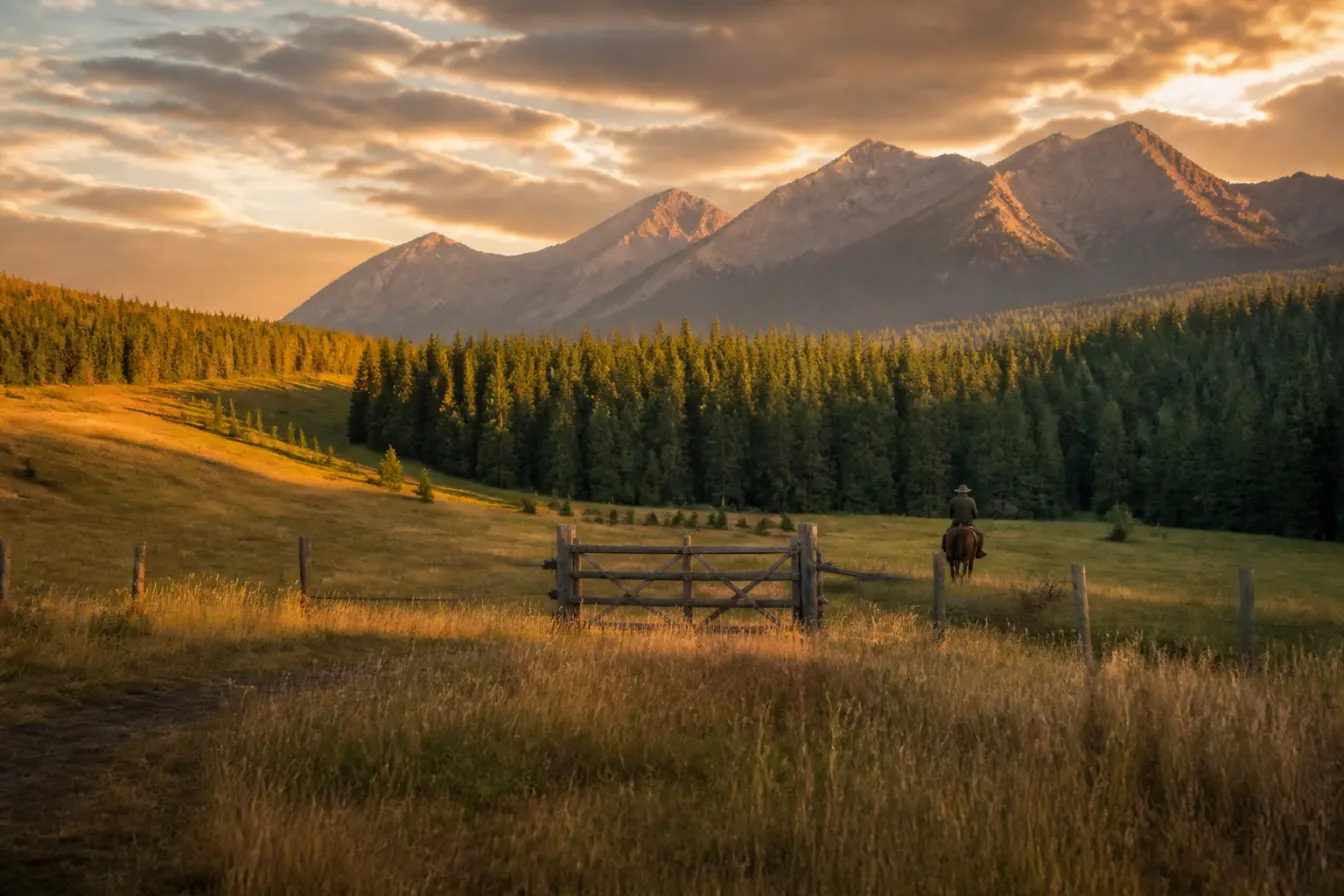
We hold an exclusive territory and a government tag allocation. We do not own or stock the land. The animals are wild. That is the whole difference.
Access, wildness and price, side by side
The two models solve the same problem, a public draw you might not win, in opposite ways. A ranch gives you certainty by controlling a property. An allocation gives you certainty by controlling a tag in a wild territory. Line them up and the trade-offs are clear.
| Private land (US ranch) | Outfitter allocation (Canada) | |
|---|---|---|
| Access certainty | High: pay for the property | High: tag via exclusive allocation |
| Who controls the animals | Ranch manages the herd | No one: wild on public land |
| Wildness of the hunt | Managed, varies by operation | Wild by law, unstocked country |
| Draw required | No | No, aliens use allocation only |
| Price driver | Property quality and management | Species, territory and allocation scarcity |
Why the prices look different
Price follows what each model actually sells. A ranch prices its property, its management and the certainty it provides, so a well-managed private-land elk hunt can carry a strong number for what is, in effect, a controlled outcome on known ground. An allocation hunt prices the species, the scarcity of the government tags and the days it takes to hunt wild country, which is why guided elk across Canada commonly runs from about $5,000 to $12,000 USD, why a low-quota bighorn tag can sit between $45,000 and near $100,000, and why the rarer the allocation, the higher and earlier it books. You are not paying for a manicured property. You are paying for a wild tag and the effort to fill it.
Neither is the honest deal and the other a rip-off. They price different things. The question is which thing you want to own for the length of a hunt: a managed property with a predictable result, or a season in wild, unstocked country with a tag no one else can touch. Our published rates and the full picture sit on our Alberta hunts page.
Why the fair-chase hunter picks the allocation
Be fair to both and the choice still comes down to what you are chasing. If your priority is a contained, predictable hunt on known ground and you value certainty of outcome above all, a good private-land ranch is a legitimate and sometimes excellent option, and we would rather you booked one you love than a wilderness hunt you were not ready for. But if what draws you is fair chase, wild animals on wild land that no one owns or feeds, then the allocation system is built for exactly that. It hands you the same certainty of access, through the tag and the exclusive territory, without turning the hunt into a managed transaction. You skip the draw, you get a wild hunt, and the country stays country. For the hunter who wants both the sure tag and the wild hunt, the Canadian allocation is the pick. Tell us your species and your window and we will map it to real availability in our territory.
Common questions
Q. What is the difference between a private-land hunt and an allocation hunt?
A private-land hunt buys access to a ranch or leased property where the owner manages the herd. An allocation hunt buys a government tag in an outfitter's exclusive territory, where the animals are wild on public land and no one owns or stocks them.
Q. Do I need to win a draw to hunt in Canada as a non-resident?
No. Non-resident aliens cannot enter the Alberta draws at all and obtain their licences through outfitter allocations only. That is the point of the system: your tag comes through the outfitter's allocation, not a lottery.
Q. Does the outfitter own the land you hunt?
No. We hold an exclusive territory and a government allocation of tags, so no other outfitter operates our country, but we do not own, fence, feed or stock the land. The animals are wild animals on public wilderness.
Q. Which is cheaper, a ranch hunt or an allocation hunt?
They price different things, so neither is simply cheaper. A ranch prices its managed property and certainty. An allocation prices the species, the scarcity of the tag and the days it takes to hunt wild country. Guided elk in Canada commonly runs about $5,000 to $12,000 USD.
Q. Is a private-land hunt still fair chase?
It depends on the operation. A managed property is by definition managed, and the more intensively it is run, the further it sits from a wild hunt. The Canadian allocation system keeps the animals wild on unstocked public land by law, which is why fair-chase hunters lean toward it.
Keep reading
Plan your hunt
Ask us about wild-country allocation hunts in our territory
Tell us what you are after. We reply within 1 to 2 business days with honest numbers, real dates and the outfitters we would send our own family to. It costs you nothing.