Regulations
Bringing firearms into Canada to hunt
Yes, you can bring your rifle. Here is the process, form number and fee.
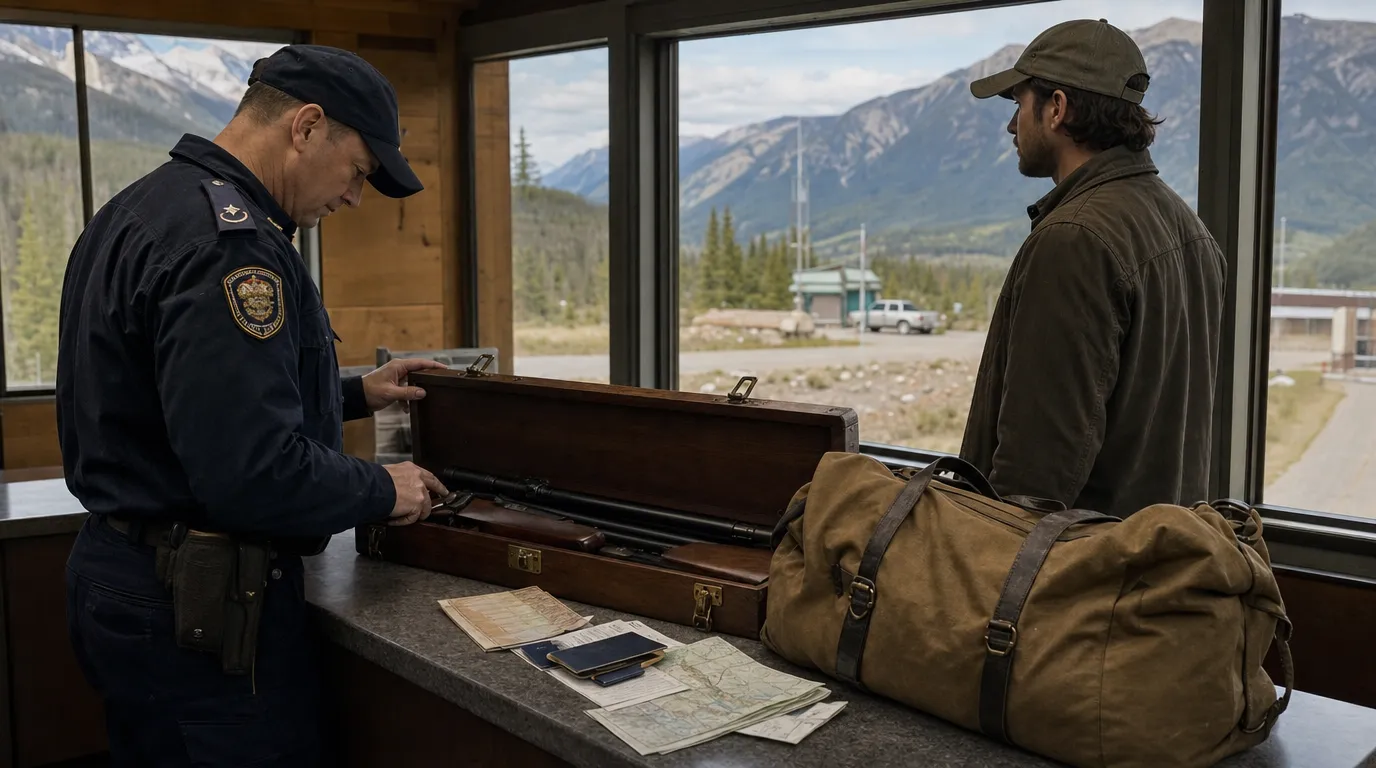
Non-resident hunters bring their own hunting rifles into Canada by filing a Non-Resident Firearm Declaration, RCMP Form 5589, at the border. You fill it out in advance but sign it in front of a border officer, pay a flat CAN$25 no matter how many guns you declare, and the witnessed declaration then works as a temporary firearms licence valid for 60 days. That declaration also authorizes you to buy ammunition in Canada. The hard limits: non-restricted long guns only for hunting, no handguns, and a five-round magazine cap on semi-automatic centre-fire long guns. This page walks the process, the limits, and how your outfitter fits in.
The declaration process, confirmed
- File RCMP Form 5589, the Non-Resident Firearm Declaration; use Form 5590 as a continuation sheet if you are bringing three or more firearms.
- The fee is a flat CAN$25 regardless of how many firearms you declare, paid at the border.
- Sign it in front of a border services officer (do not sign in advance); the witnessed declaration is valid as a temporary licence for 60 days and authorizes ammunition purchase in Canada.
- Bring non-restricted long guns only for hunting. No handguns; leave them home. Semi-automatic centre-fire long guns are capped at a five-round magazine.
- Wolf and black bear are CITES-listed, so they carry separate export paperwork on the way home; see meat and trophy export.
The numbers that matter
RCMP Form 5589 (5590 continuation for three or more guns), flat CAN$25, doubles as a 60-day temporary licence, authorizes ammo purchase. Non-restricted long guns only, no handguns, five-round magazine cap on semi-auto centre-fire. Sources: rcmp.ca and cbsa-asfc.gc.ca. Verified July 2026.
Bring your own rifle, or borrow one there?
This is the practical fork most hunters hit first, and it is a logistics question more than a legal one, so we can talk about it honestly. Bringing your own rifle means you hunt with a gun you have zeroed and trust, but you take on the declaration process at the border and the hassle of flying with a firearm. Borrowing or renting a rifle from the outfitter, where that is offered, means nothing to declare on the way in and one less case to check, at the cost of hunting with iron you have not shot much.
We will not claim any specific outfitter provides loaner rifles unless it is in their own materials, so treat this as a question to ask on your booking call: can the outfitter arrange a rifle, in what calibers, and what do their clients usually do. If you do bring your own, the declaration process is straightforward and cited above: Form 5589, $25, non-restricted long guns only. The part worth sorting early is your airline's firearm and ammunition rules.
What still needs your own check
The core process, the form, the fee and the limits are settled and cited above from the RCMP and the CBSA. What still varies is the travel side: airlines set their own firearm and ammunition rules, and those are the piece to confirm with your carrier. Your outfitter processes client firearms every season and can tell you exactly what their hunters do. Verified July 2026.
- Airline firearm rules for your specific carrier and any connecting airports, which sit on top of the border process.
- How much ammunition your airline and the border allow you to carry, and how it must be packed.
- Any provincial rule on top of the federal declaration for the area you are hunting.
- Whether you want to pre-fill Form 5589 online before you travel to speed up the crossing (you still sign it at the border).
How your outfitter fits in
The reason we keep pointing at the outfitter is not a dodge, it is where the real knowledge lives. An operation that runs non-resident hunters season after season has walked clients through the border with rifles many times, and knows the current form, the fee, and the common mistakes. Ask them early, treat their answer as the working plan, and verify the legal specifics against the official federal source yourself. That combination, the outfitter's lived experience plus the official current figures, beats any third-party listicle. When you are choosing who to hunt with, how clearly they answer this kind of question is itself a signal; see how to choose an outfitter.
Give the paperwork a runway
Firearm importation and the export paperwork on the back end both reward planning ahead. Sort the declaration process weeks before you travel, not at the airport, and if you plan to take a wolf as a free add-on to your hunt, start the CITES export process early too, since that is a separate step covered on our meat and trophy export page. Book the hunt, then handle firearms and export as their own line items on your timeline, the same way you would licences and travel.
The practical side of flying with a rifle
Set aside the legal specifics we are verifying and there is still a logistics job to get right, and this part is the same whether you are going to Alberta or anywhere else. Your rifle travels in a hard, lockable case as checked baggage, and airlines have their own firearm rules on top of the border process, so confirm your specific carrier's requirements and how connecting airports handle a firearm before you book flights. Build in margin: a missed connection with a firearm is a bigger problem than a missed connection with a duffel.
On arrival, the outfitter or their transport meets you, and from there the gun is in a working hunting camp rather than an airport, which is one more reason to have talked the whole chain through with them in advance. A good outfitter will tell you what their clients typically pack, how they handle the rifle between the airport and camp, and what has gone wrong for past hunters so you can avoid it. Treat the travel-day plan as seriously as the hunt plan, because a rifle that does not arrive with you is a hunt that does not happen. None of this replaces confirming the actual importation rules with official sources, which stays on your pre-trip list.
Common questions
Q. Can I bring my own rifle to hunt in Canada?
Yes. Non-residents bring non-restricted hunting long guns into Canada by filing RCMP Form 5589 at the border. Handguns are not allowed for hunting, and semi-automatic centre-fire long guns are capped at a five-round magazine.
Q. What is the firearm declaration fee to enter Canada?
A flat CAN$25, regardless of how many firearms you declare. The signed, witnessed declaration doubles as a temporary firearms licence valid for 60 days and authorizes you to buy ammunition in Canada. Verified July 2026.
Q. Should I bring my own rifle or borrow one from the outfitter?
It is a trade-off. Your own rifle means familiar iron plus a $25 border declaration; a loaner, where offered, means nothing to declare but an unfamiliar gun. Ask your outfitter whether they can arrange a rifle and what their clients usually do.
Q. Does my outfitter help with the firearm paperwork?
Outfitters deal with client firearm importation every season and can walk you through Form 5589 and the crossing. Ask them directly as part of booking; the form, the $25 fee and the limits are set by the RCMP and CBSA.
Q. Can I bring ammunition into Canada for my hunt?
Yes. The signed Form 5589 declaration authorizes ammunition purchase in Canada, and hunters also carry their own. Confirm your airline's ammunition packing and quantity rules before you fly, since carriers set their own limits on top of the border process.
Q. Can I bring a handgun to hunt in Canada?
No. Handguns are restricted and are not permitted for hunting in Canada. Bring non-restricted long guns only, and leave handguns at home. Verified July 2026.
Keep reading
Plan your hunt
Ask us about what your outfitter needs for your firearms
Tell us what you are after. We reply within 1 to 2 business days with honest numbers, real dates and the outfitters we would send our own family to. It costs you nothing.