Regulations
Do you need a guide to hunt in Canada?
The short answer across the West, the North and the East: yes.
If you are a non-resident, yes, you generally need a guide to hunt big game in Canada. In Alberta, British Columbia, the Yukon and the Northwest Territories, a non-resident must be accompanied by a licensed outfitter-guide, and the same requirement now traces to official sources in Saskatchewan, Manitoba and Newfoundland too. Alberta adds one alternative: an unpaid Alberta-resident hunter host who has not hosted a non-resident alien in the previous two fiscal years. This is not a formality or a technicality you can plan around. It is the legal path a non-resident takes to hunt these jurisdictions, and it decides how you get a tag, who you hunt with, and what your trip costs.
The requirement by province and territory
Here is the requirement we can cite to the official provincial and territorial authorities. Every row below traces to the government source named in the last column, and we date-stamp it because stale regulations are the single most common error on competing pages. If a claim is not in this table, treat it as something to confirm, not something we are asserting.
| Jurisdiction | Non-resident requirement | Source |
|---|---|---|
| Alberta | Outfitter-guide, or unpaid resident hunter host | mywildalberta.ca |
| British Columbia | Guide outfitter, assistant guide, or resident with Permit to Accompany | gov.bc.ca |
| Yukon | Registered outfitter (Canadians may use a special guide licence) | yukon.ca |
| Northwest Territories | Outfitter required for big game | gov.nt.ca |
| Saskatchewan | Outfitter and guided licence for big game; out-of-province Canadians: moose only | publications.saskatchewan.ca |
| Manitoba | Outfitter plus a licensed Manitoba guide, max 4 hunters per guide; out-of-province Canadians: moose only | gov.mb.ca |
| Newfoundland | Licensed guide required; big game licences sold through outfitters only | gov.nl.ca |
Non-resident vs non-resident alien: the distinction that matters
Two categories of hunter run into this rule, and a lot of online advice blurs them. A non-resident Canadian is a Canadian who lives outside the province they want to hunt. A non-resident alien is a hunter from outside Canada, meaning most Americans and Europeans. Both are bound by the accompanied-hunt requirement in Alberta, BC, Yukon and NWT, but the two are not treated identically when it comes to tags.
Per the official Alberta authority, non-resident aliens cannot enter Alberta draws at all. They obtain tags only through an outfitter's allocation. Non-resident Canadians can enter some draws, but they are still bound by the requirement to be accompanied by an outfitter-guide or an unpaid hunter host. So even a Canadian from the next province over does not simply drive to Alberta and hunt alone. Verified July 2026. This is why the outfitter is central: for the visiting hunter, the outfitter is not an upsell, it is the mechanism.
Alberta: the hunter host wrinkle
Alberta is the one jurisdiction on our list with a non-outfitter option, and it is narrower than it sounds. Per the official Alberta authority, non-residents and non-resident aliens hunting big game, wolf or coyote must be accompanied by a hunter host or an outfitter-guide. The hunter host must be an Alberta resident, cannot be paid, and cannot have hosted a non-resident in the previous two fiscal years. That two-year cooldown and the no-payment condition exist to stop the hunter host from becoming a backdoor commercial guide, and together they close the door for almost everyone who does not already have a willing Alberta friend. We break the rule down in full on the hunter host rule explained.
The guide is the whole point
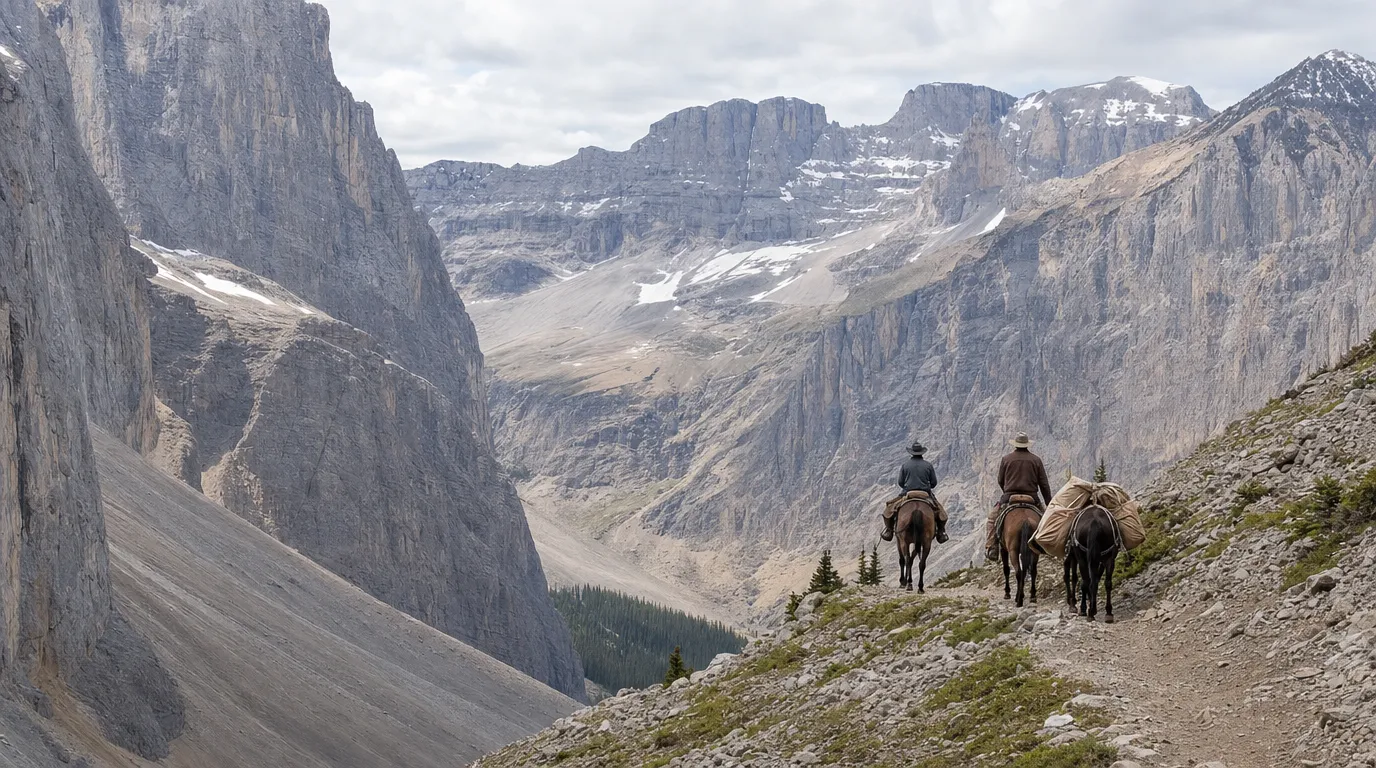
The law does not just permit a guide, it requires one. We treat that as the feature, not the fee: the guide is the person who turns a tag into a real hunt in real country, on horseback and foot, in ground you could never legally reach alone.
British Columbia, Yukon and the Northwest Territories
In British Columbia, every non-resident big game hunter must be accompanied by a licensed guide outfitter, an assistant guide, or a resident holding a Permit to Accompany. Guide outfitters hold exclusive territories under government allocation, which means the outfitter you book is tied to specific country, not a floating service. Verified July 2026.
In the Yukon, non-residents must hunt big game with a registered outfitter. Canadian non-residents have one extra path, a special guide licence, but for a hunter arriving from outside Canada the registered outfitter is the route. In the Northwest Territories, non-residents require an outfitter for big game, full stop. Verified July 2026. Across all three, the outfitter's allocation is what makes your hunt legal, so the choice of outfitter and the choice of hunt are the same decision.
What the guide requirement actually buys you
Because the law requires a guide anyway, the real question is not whether to hire one but which one, and what you get. A serious outfitter is doing more than checking a legal box. On our Alberta Rockies hunts, the hunt price includes guiding, accommodations, meals, in-field transport, airport transfers, and pre and post-hunt lodging, plus animal preparation and airline-ready packaging. What that buys is access: the allocation that produces your tag, the horses and camps that reach country closed to trucks, and someone who has hunted that ground for years. You are still on the hook for licences and tags, GST, tips, airfare, taxidermy and export, which is why we publish full cost guides that show the whole stack.
Saskatchewan, Manitoba and Newfoundland
The prairie and eastern provinces run the same play as the West, and we can now cite each one to its official guide. Per the Saskatchewan 2025-26 Hunters Guide, all non-resident big game hunters (white-tailed deer, moose, bear and wolf) and Canadian resident moose hunters must use the services of an outfitter and hold the appropriate guided licence. Read that carefully: a hunter from outside Canada needs an outfitter for every big game species, while an out-of-province Canadian needs one for moose specifically, with black bear and draw whitetail optional. Verified July 2026.
Per the official Manitoba 2025 Hunting Guide, a non-Canadian resident must book big game (moose, whitetail, black bear) through a licensed lodge or outfitter and be accompanied by a licensed Manitoba guide, with a maximum of four hunters per guide. An out-of-province Canadian needs the outfitter and guide for moose only. One accuracy note: a separate tourism site contradicts the gov.mb.ca guide on moose, and the official government guide is the one that controls. Verified July 2026.
Per the official Newfoundland and Labrador wildlife authority, non-resident big game hunters are required to be accompanied by licensed guides, and non-resident big game licences are only available through licensed outfitters. So in Newfoundland the licence itself flows through the outfitter, which is the same access logic as an Alberta allocation. Verified July 2026. The full budget-moose picture is on the Newfoundland province hub.
Common questions
Q. Can Americans hunt in Canada without a guide?
Not for big game in Alberta, BC, Yukon, NWT, Saskatchewan, Manitoba or Newfoundland. Non-resident aliens must hunt with a licensed outfitter-guide, and in Alberta cannot even enter draws; tags come through outfitter allocations.
Q. Do non-resident Canadians need a guide too?
Yes in most provinces. A Canadian hunting a province they do not reside in is a non-resident there. In Alberta, BC, Yukon and NWT that means an outfitter-guide for big game (or in Alberta an unpaid resident hunter host); in Saskatchewan and Manitoba an out-of-province Canadian needs the outfitter for moose specifically. Canadians can enter some Alberta draws; aliens cannot.
Q. Is there any way to hunt Alberta without an outfitter?
Only with an unpaid Alberta-resident hunter host who has not hosted a non-resident alien in the previous two fiscal years. For most visiting hunters that person does not exist, so an outfitter is the route.
Q. Which Canadian provinces require a guide for non-residents?
We can cite the requirement to official sources for Alberta, British Columbia, Yukon, the Northwest Territories, Saskatchewan, Manitoba and Newfoundland. The exact scope differs by residency: aliens need an outfitter for big game everywhere listed, while out-of-province Canadians face a narrower moose-focused rule in Saskatchewan and Manitoba.
Q. Why does Canada require a guide for non-residents?
Each province and territory sets the rule to manage allocations and non-resident access. The practical effect is that the outfitter is your legal path to hunting the country, and the holder of the allocation that produces your tag.
Q. Does the guide requirement apply to small game?
Our verified source covers big game (and in Alberta, wolf and coyote). Rules for other species vary by jurisdiction, so confirm the specific requirement with the official provincial authority before you travel.
Keep reading
Plan your hunt
Ask us about which province fits your hunt
Tell us what you are after. We reply within 1 to 2 business days with honest numbers, real dates and the outfitters we would send our own family to. It costs you nothing.