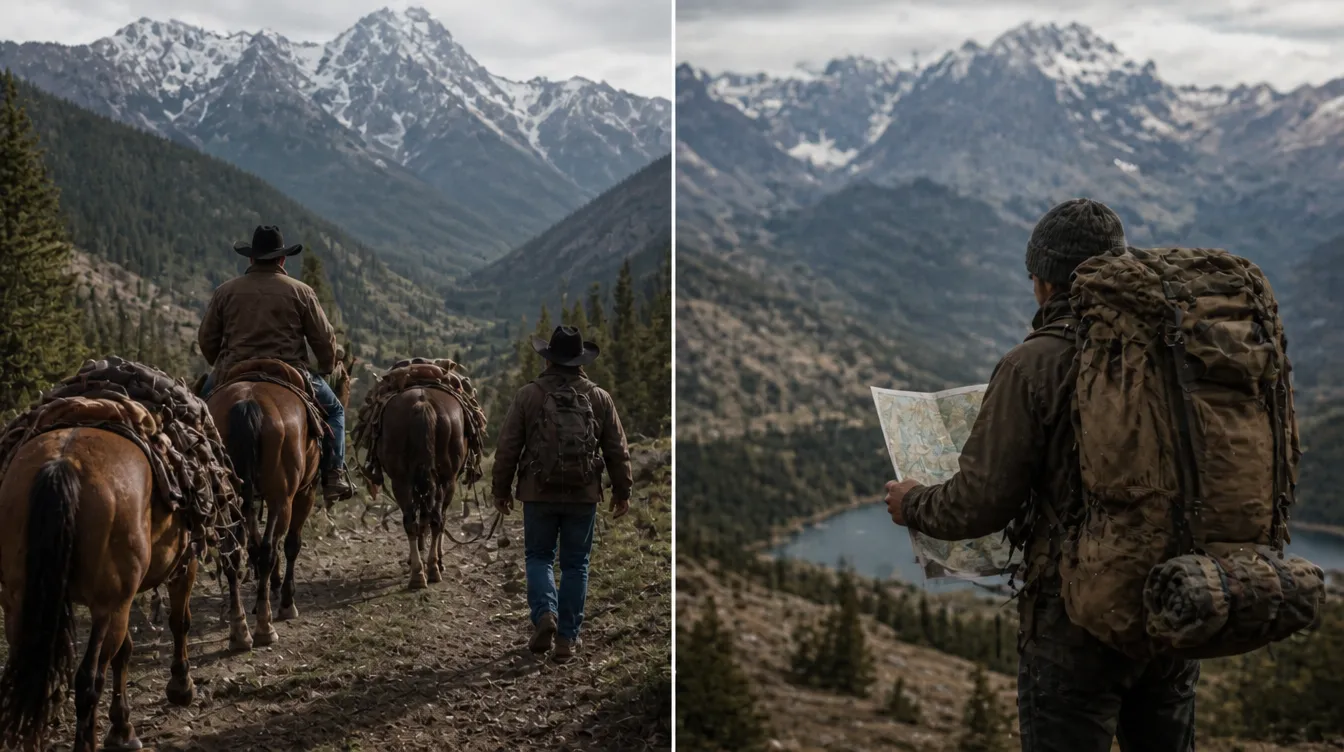
Comparison
Guided vs DIY hunting in Canada
For a non-resident in the Canadian West, DIY is not on the menu.
The honest version of guided vs DIY for a non-resident in western Canada is short: DIY is not a legal option. In Alberta, British Columbia, the Yukon and the Northwest Territories a non-resident must hunt big game with a licensed outfitter-guide. Alberta allows an unpaid resident hunter host instead, but that person must be an Alberta resident, cannot be paid, and cannot have hosted in the previous two fiscal years, so it rarely applies to a visitor. That means the real question is not guided versus DIY inside Canada; it is a Canadian guided hunt versus a DIY hunt back home. Below is the legal reality, what the guide fee actually buys, and the honest cons.
Why DIY is not the choice here
Every western and northern jurisdiction we cover requires non-residents to hunt accompanied for big game. There is no self-guided non-resident big game hunt in Alberta, BC, Yukon or NWT. The Alberta hunter-host route is the only unguided path, and its rules are strict enough that most visiting hunters cannot use it: the host must be an Alberta resident, the host cannot be paid, and the host cannot have hosted anyone in the previous two fiscal years. No Alberta friend who fits that description means you need an outfitter. See the Alberta hunter host rule for the full detail.
The rules narrow further north. In the Yukon a non-resident must hunt big game with a registered outfitter, though a Canadian non-resident may instead use a special guide licence. In the Northwest Territories a non-resident requires an outfitter for big game. British Columbia is blunt about it: all non-resident big game hunters must be accompanied by a licensed guide outfitter, an assistant guide, or a resident holding a permit to accompany, and the guide outfitters hold exclusive territories under government allocation. There is no jurisdiction in this network where a visiting non-resident simply buys a big game tag and heads out alone.
So when a US hunter searches guided vs DIY for a Canadian hunt, the framing itself is off. The choice is not between paying a guide and going alone in Canada. It is between a guided Canadian hunt and a do-it-yourself hunt in a US state where you can legally self-guide. That is the comparison this page actually answers.
The guide is the access, not an upsell
Because the law requires accompaniment, the guide is what makes a non-resident hunt legal in the first place. We treat that as the point of the trip, not a cost to minimize. See do you need a guide in Canada.
The real comparison matrix
| Factor | Canadian guided hunt | DIY hunt at home |
|---|---|---|
| Legal for non-residents | Yes, required by law | Depends where home is |
| Access to tags | Through outfitter allocation | Your own draw or over-counter tags |
| Cash cost | Hunt fee plus licences and travel | Lower cash cost |
| Time and skill cost | Outfitter handles the hard parts | You scout, pack, plan and recover |
| Country and experience | Backcountry Canada, guided | Familiar, self-directed |
| What can go wrong on you | Little; the outfitter carries it | All of it is yours to solve |
What the guide fee actually buys
The cash gap between guided and DIY looks large until you price out what the fee covers. Take our Alberta hunts as a worked example of a full-service package. Our hunt price includes guides, accommodations, meals, transport during the hunt, airport transfers, pre-hunt and post-hunt lodging, and animal preparation with airline-ready packaging. Excluded are licences and tags, the WIN card, GST, airfare, tips, taxidermy and any CITES or shipment costs.
Read that inclusion list again as a DIY hunter would: on a self-guided trip, every included line becomes your job. You are the one securing lodging, hauling gear, cooking, breaking down the animal in the field and getting it packaged for the trip home. The guide fee is buying a working camp and the labor and knowledge to run it, not just a person pointing at a hillside. That is why a full-service backcountry hunt costs what it does.
The honest cons of going guided
None of that changes the legal reality in the West, but it is the honest counterweight. If self-direction and a low cash cost are what you value most, a DIY hunt in a state where you can legally self-guide is the better fit, and we will say so. If you want backcountry Canada, the guide is not optional, and the fee buys a real camp. A note on the in-between: semi-guided and drop-camp arrangements exist in some places, but for a non-resident in the Canadian West they do not create a legal self-guided option for big game.
- Cost: a guided hunt carries a real hunt fee on top of licences and travel, where a home-state DIY hunt is mostly your time.
- Less autonomy: you hunt the outfitter's ground, on the outfitter's plan and pace, not entirely your own.
- Outfitter risk: the guide makes or breaks the week, so screening the outfitter is the single most important decision.
- Lead time: good hunts book one to two years out, so guided is not a spur-of-the-moment trip.
What the DIY side actually asks of you
It is worth being fair to the DIY route, because for the right hunter in the right place it is the better call. A do-it-yourself hunt in a jurisdiction where you can legally self-guide gives you full control: your ground, your dates, your pace, and a cash cost that is mostly gear, tags and fuel. Nobody is setting the alarm or picking the ridge but you. That autonomy is the whole appeal, and no guided hunt fully replaces it.
The trade is that everything the outfitter's fee quietly covers becomes your project. You scout the country, secure the tags or draw, pack in and out, run the camp, break down and pack the animal, and solve whatever goes wrong with weather, gear or access on your own. Done well that is deeply satisfying; done underprepared in unfamiliar country it is how hunts fall apart. So the honest split is not guided-good versus DIY-bad. It is: buy a working camp and local knowledge, or provide them yourself. In the Canadian West the law makes that decision for non-residents on big game; back home, it is a genuine choice worth weighing on your own terms.
If cost is the sticking point
The lowest-cost guided options in Canada are Newfoundland moose at $5,200 to $9,500 (meat-hunt tier, no draw) and baited black bear at $2,500 to $5,000 CAD in Alberta and Saskatchewan. Those are the hunts to look at when the guided fee is the barrier. They are still guided, because for a non-resident that is the law, but they bring the price of a legal Canadian hunt down to the range of a serious DIY trip. See the most affordable guided hunt and budget Newfoundland moose.
Common questions
Q. Can a non-resident hunt Canada without a guide?
Not for big game in Alberta, BC, Yukon or NWT. A licensed outfitter-guide is required. Alberta allows an unpaid resident hunter host, but that host cannot be paid and cannot have hosted in the previous two fiscal years, so it rarely applies to a visitor.
Q. Is a guided Canadian hunt worth it versus DIY?
For a non-resident in the Canadian West it is not a choice, guided is required. The worthwhile comparison is a Canadian guided hunt versus a DIY hunt in a home jurisdiction where you can legally self-guide.
Q. What does a guided hunt fee include?
It varies by operator, but a full-service package like ours covers guides, accommodations, meals, in-field transport, airport transfers, pre and post-hunt lodging, and animal prep with airline-ready packaging. Licences, GST, airfare, tips, taxidermy and export are typically extra.
Q. What is the cheapest way for a non-resident to hunt Canada?
The lowest-cost guided options are Newfoundland moose ($5,200 to $9,500) and baited black bear ($2,500 to $5,000 CAD). DIY is not available to non-residents for big game in the West.
Q. Is a semi-guided or drop-camp hunt an option for non-residents?
Not as a way around the accompaniment law for big game in the Canadian West. Those arrangements exist in some places, but they do not create a legal self-guided non-resident big game hunt in Alberta, BC, Yukon or NWT.
Q. Can I use an Alberta friend instead of paying an outfitter?
Only if that friend qualifies as a hunter host: an Alberta resident, unpaid, who has not hosted anyone in the previous two fiscal years. If nobody you know fits, you need an outfitter.
Keep reading
Plan your hunt
Ask us about a guided hunt that fits, since DIY is not an option
Tell us what you are after. We reply within 1 to 2 business days with honest numbers, real dates and the outfitters we would send our own family to. It costs you nothing.