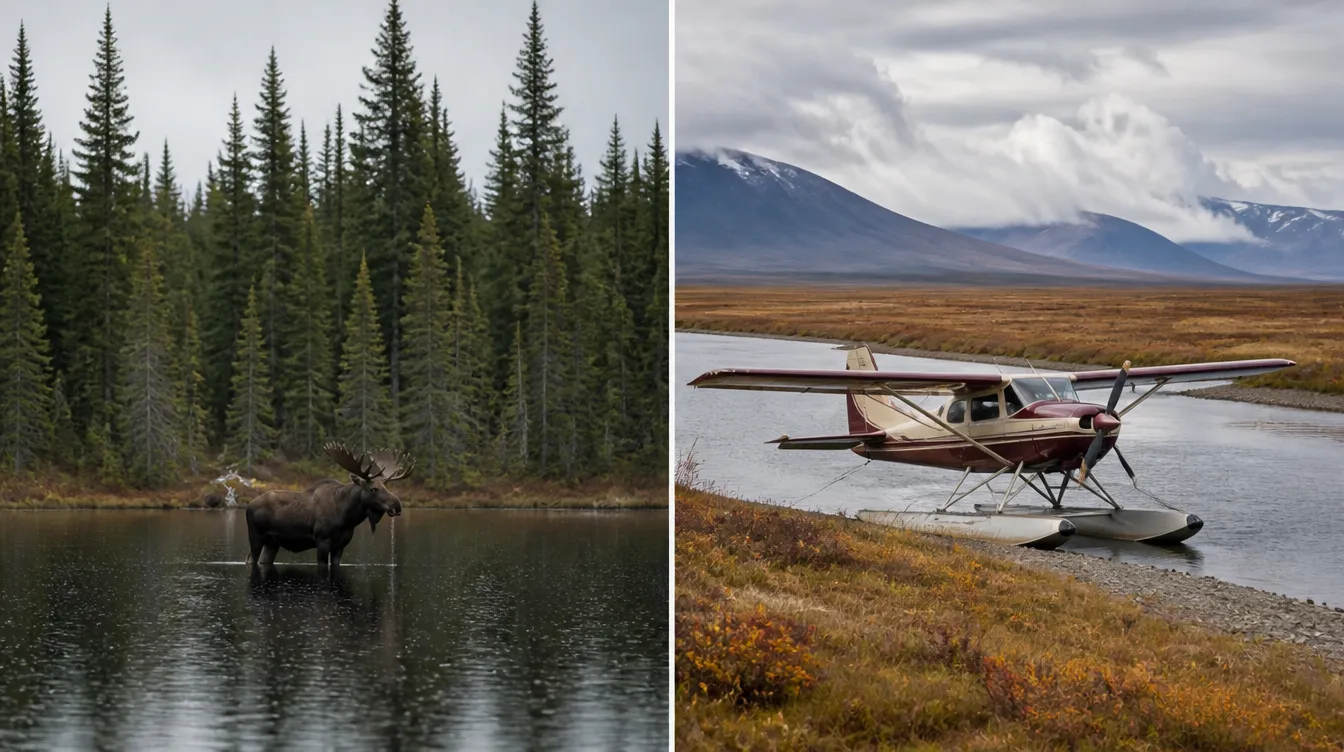
Comparison
Canada vs Alaska moose hunting
Guided Canada undercuts guided Alaska by tens of thousands.
Hunters comparing Canada and Alaska for moose usually fixate on antler size, but the two differences that decide most trips are cost and access. Guided Canadian moose runs $5,200 to $9,500 in Newfoundland, $7,500 to $20,000 in British Columbia, and $15,500 to $17,500 USD plus GST in Alberta. Guided Alaska moose, by market reports, runs US$28,000 to $45,000, with cheaper drop hunts around $10,500 to $14,500 plus the bush charter. So a fully guided Canadian mountain hunt undercuts a guided Alaska hunt by tens of thousands of dollars. Add the access point, that a Canadian non-resident tag comes through an outfitter's allocation with no points to bank, and the comparison is not close for most hunters. What follows lays out the guide law, the official fees and the honest trade-offs on both sides.
The comparison matrix
| Factor | Canada (guided) | Alaska |
|---|---|---|
| Guided hunt cost (USD) | $5,200 - $17,500 by province | $28,000 - $45,000 (market); drop hunts $10,500 - $14,500 + charter |
| Access model | Outfitter allocation, plan a specific year | Draw or points in many areas |
| Guide requirement (moose) | Required for non-residents (AB, BC, YT, NWT) | Not required for US nonresidents; required for nonresident aliens |
| Licence and tag (USD) | See province licence rows | Nonresident licence $160 + moose tag $800 ($1,000 alien) |
| Logistics | Road, horseback or fly-in by province | Commonly remote fly-in plus bush charter |
| Certainty of hunting a given year | High via allocation | Depends on draw odds |
Access is the whole ballgame
The reason access matters more than antlers is simple: a bigger bull you can never draw a tag for is worth less than a good bull you can hunt next fall. In western Canada, a non-resident hunts moose through a licensed outfitter who holds a government allocation. There is no personal points balance to grow over years. You choose the outfitter, you book the year, you go. Alberta aliens cannot even enter the draws; the outfitter allocation is the only path, which paradoxically makes planning easier, not harder.
One nuance the competitor pages usually flatten: in Canada, non-resident aliens (Americans, Europeans) and non-resident Canadians are treated differently. Aliens cannot enter Alberta big game draws at all and must go through an outfitter's allocation, while non-resident Canadians can enter some draws but still fall under the accompaniment rule for big game. The Yukon adds its own wrinkle, where a Canadian non-resident may use a special guide licence as an alternative to a registered outfitter. If you are Canadian rather than American, that is worth confirming for the specific province, because your paths are slightly wider.
Alaska's guide law is the twist most hunters miss. Under AS 16.05.407, a nonresident needs a registered guide for brown or grizzly bear, mountain goat and sheep, but not for moose. So a US nonresident can legally hunt Alaska moose unguided, which is the do-it-yourself route Alaska is famous for. A nonresident alien, meaning a hunter from outside the US, does need a guide for any big game including moose. Many Alaska areas also run on draws or point systems that differ area to area, so verify the current draw structure for your unit with Alaska Department of Fish and Game before you build a plan around it. Verified July 2026.
Cost, honestly on both sides
On the Canadian side the numbers are official and sourced. Newfoundland runs $5,200 to $9,500 with an outfitter-only moose licence of $502 CAD. British Columbia runs $7,500 to over $20,000 depending on the guide territory, with a non-resident alien licence of $180 (Canadian $75) plus a $250 moose species licence, all CAD. Alberta premium one-on-one rut hunts are $15,500 to $17,500 USD plus 5% GST, with lower-end all-in Alberta hunts from $8,000 to $15,000. For a concrete anchor, our Alberta hunts run a 10-day moose hunt at $17,500.
On the Alaska side the official fees are modest, in USD: a nonresident licence is $160 and a moose tag is $800 ($1,000 for a nonresident alien). The hunt itself is where the gap opens. Guided Alaska moose is reported at US$28,000 to $45,000 in the market, with cheaper drop-camp hunts around $10,500 to $14,500 before you add the bush charter. Those guided-hunt figures are a secondary market range rather than a single official price, so treat them as the going rate, not a quote.
Put the two side by side and the headline writes itself. A fully guided Canadian mountain moose hunt at $7,500 to $17,500 undercuts a guided Alaska hunt at $28,000 to $45,000 by tens of thousands of dollars, for the same species and a comparable full-service experience. Even Alaska's DIY drop hunt, once you add the charter, the tag and your own logistics, lands in the same range as a fully guided Newfoundland or BC hunt where the outfitter carries the work. The full Canadian breakdown, line by line, is in the moose hunt cost guide.
Guide rules and logistics
Canada's guide requirement for non-residents is documented: in Alberta, British Columbia, the Yukon and the Northwest Territories a non-resident must hunt big game accompanied by a licensed outfitter-guide. That is not an upsell, it is the law that turns a licence into a legal hunt. See non-resident hunting licences for the per-jurisdiction detail.
The Canadian rule is also consistent across the West and North: Alberta, British Columbia, the Yukon and the Northwest Territories all require a non-resident to hunt big game with a licensed outfitter, with the Yukon offering a Canadian non-resident the alternative of a special guide licence. You are never guessing whether a guide is legally required in these provinces, it always is. Alaska is different for moose specifically: under AS 16.05.407 a US nonresident does not need a guide for moose (only for brown bear, goat and sheep), while a nonresident alien needs a guide for any big game. On logistics, Canadian moose hunts range from road and horseback to fly-in depending on the province, while Alaska moose hunts are commonly remote fly-in plus a bush charter, which is a real cost line on top of the hunt.
Want a moose this year, not in five?
That is the Canadian pitch: an outfitter allocation instead of a points wait. When Alberta is the fit, that is our country; tell us your budget and dates and we will give you straight answers.
Antler size, the part everyone asks about
Since antlers are what pulls most hunters toward Alaska in the first place, here is the honest Canadian side. On the sourced end, our Alberta hunts report bulls averaging 50 inches and over on our backcountry rut hunt, which runs only four hunts a year. British Columbia produces large bulls in certain guide territories, though we do not hold a province-wide figure to quote. Newfoundland we treat as a meat-and-experience province because we have no trophy data for it in our verified sources.
Alaska moose carry a big reputation for sheer size, and it may well be deserved. But weigh that against what the reputation costs: a guided Alaska bull at $28,000 to $45,000 is two to five times the price of a guided Canadian one, and unless you are a US resident willing to run a genuine DIY hunt, you are paying it. If antler size is the deciding factor, decide honestly whether the extra inches are worth tens of thousands of dollars over a sourced Canadian expectation you can actually plan and book.
The honest takeaway
The honest summary is that Canada wins on both cost and certainty for most hunters. A guided Canadian moose hunt at $7,500 to $17,500 undercuts a guided Alaska hunt at $28,000 to $45,000 by a wide margin, and the outfitter-allocation model means no points to bank and no lottery to lose. Alaska keeps two edges: a US resident can hunt moose DIY without a guide, and the state has its big-bull reputation. If those matter more to you than the price gap and the booking certainty, verify the current draw odds and unit rules with Alaska Department of Fish and Game. When the plan is Alberta, that is our country; tell us your budget and dates and we will give you straight answers.
Common questions
Q. Is it easier to draw a moose tag in Canada or Alaska?
In western Canada a non-resident's tag comes through an outfitter's allocation, so you can plan for a specific year without accumulating points. Many Alaska areas run on draws or points; verify current odds directly. That access difference is Canada's main practical advantage.
Q. Are Canadian moose as big as Alaska moose?
Alaska has the bigger-bull reputation. Our Alberta hunts report bulls averaging 50 inches and over, and BC produces large bulls in some territories. The honest question is whether Alaska's edge is worth two to five times the guided price.
Q. How much does a Canadian moose hunt cost versus Alaska?
Guided Canadian moose runs $5,200 to $17,500 by province. Guided Alaska moose is reported at US$28,000 to $45,000 in the market, with DIY drop hunts around $10,500 to $14,500 plus a bush charter. Canada undercuts a guided Alaska hunt by tens of thousands.
Q. Do you need a guide for moose in Canada?
Yes, as a non-resident in Alberta, BC, Yukon and NWT a licensed outfitter-guide is required. Newfoundland hunters also book through outfitters in practice.
Q. Do you need a guide for moose in Alaska?
Not if you are a US nonresident. Under AS 16.05.407 a guide is required for brown bear, mountain goat and sheep, but not moose, so US hunters can hunt Alaska moose DIY. A nonresident alien does need a guide for any big game. Verified July 2026.
Q. How much is an Alaska moose licence and tag?
For a nonresident, a hunting licence is US$160 and a moose tag is $800 ($1,000 for a nonresident alien). Those official fees are modest; the guided hunt price of $28,000 to $45,000 is where Alaska gets expensive. Verified July 2026.
Q. Which has better logistics, Canada or Alaska?
Canadian moose hunts range from road and horseback to fly-in depending on the province, so you can often pick a less remote option. Alaska hunts are commonly remote fly-in, but confirm the specific area.
Keep reading
Plan your hunt
Ask us about a Canadian moose hunt you can book this year
Tell us what you are after. We reply within 1 to 2 business days with honest numbers, real dates and the outfitters we would send our own family to. It costs you nothing.