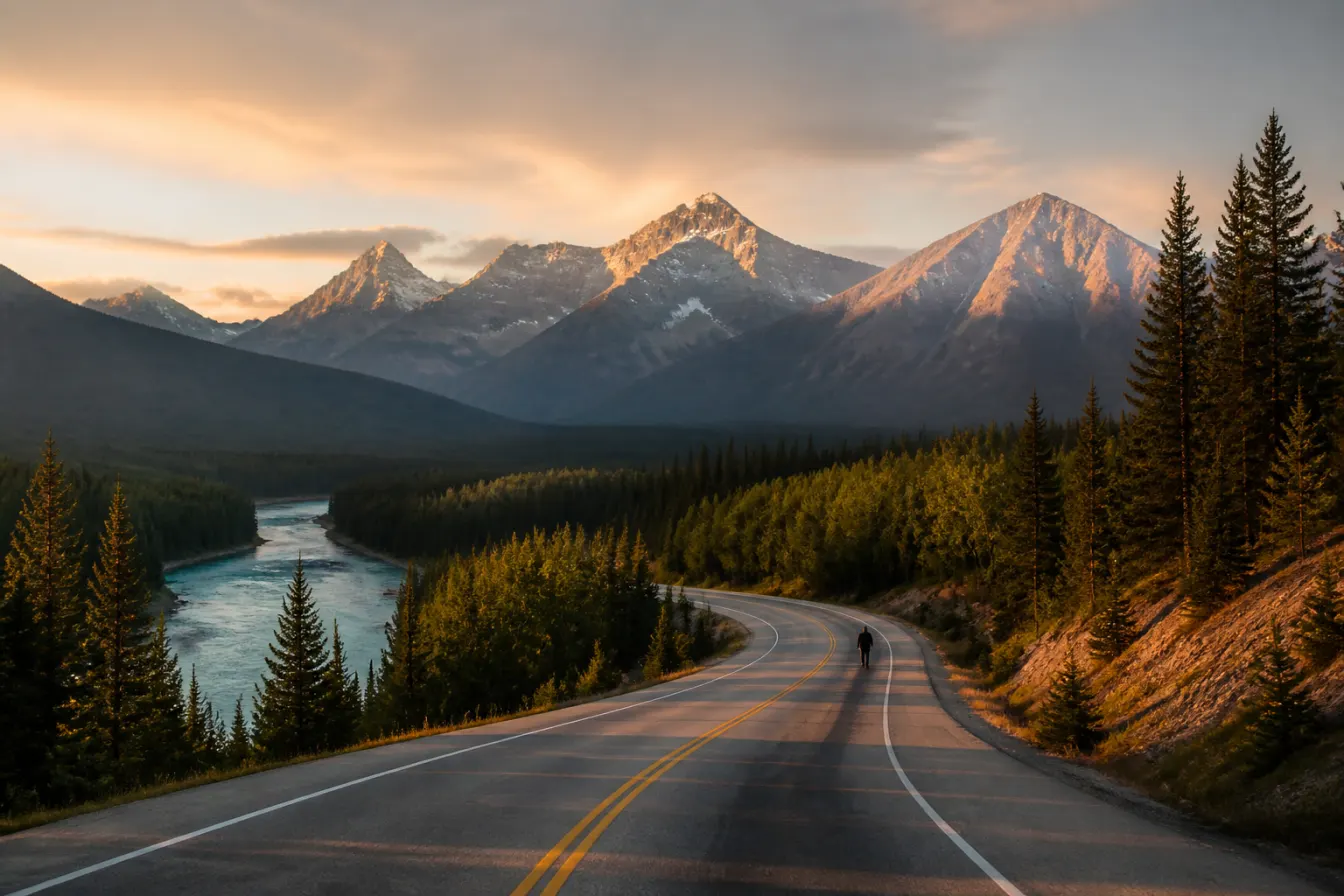
Nordegg country
The David Thompson Highway (Hwy 11): Road Trip Guide
The quiet back road into the Rockies: Rocky Mountain House to the Icefields Parkway, and what to see along the way.
The David Thompson Highway is Highway 11, and it is one of the best and least crowded scenic drives in the Canadian Rockies. It runs west from the town of Rocky Mountain House, across the Alberta foothills, through the hamlet of Nordegg, along the turquoise length of Abraham Lake, and up to meet the Icefields Parkway near Saskatchewan River Crossing. Named for the explorer and mapmaker who charted this country two centuries ago, it is the back door into the mountains, quieter and wilder-feeling than the famous corridor through Banff and Jasper. This is our home stretch of road, the route our hunters drive in on. Below is the arc of the drive from east to west, the main stops worth pulling over for, and the plain practicalities of a foothills-to-mountains highway that has long empty gaps between services. Plan it as a slow day, not a dash, and it rewards you.
The arc of the drive, east to west
Think of the David Thompson Highway as a steady climb from farmland into the Rockies. At the eastern end, Rocky Mountain House sits where the prairie gives way to foothills. As you drive west the country gets rougher and more forested, the hills rise into ridges, and by the time you reach Nordegg you are firmly in the foothills. West of Nordegg the road climbs alongside Abraham Lake with the front ranges of the Rockies standing up ahead, and it finishes by joining the Icefields Parkway at Saskatchewan River Crossing, deep in the mountains.
That whole run is the appeal. Most people who visit the Alberta Rockies only ever drive the busy Trans-Canada and Icefields Parkway corridor. Highway 11 is the road that comes at the same mountains from the east, through country most visitors never see, and it does it with a fraction of the traffic.
The name is worth a moment too. David Thompson was one of the great surveyors and mapmakers of this continent, and he worked his way through this very country two centuries ago, charting rivers and passes long before there was a road. Driving the highway that carries his name, with the North Saskatchewan River threading the valley beside you, is a small way of following the same route he did. It gives the drive a sense of place that a numbered highway sign never suggests on its own.
What to stop for
The joy of this highway is the stops, and there are more than a first-timer expects. Here are the main ones people ask us about, running from the Nordegg area westward. Treat this as a menu, not a checklist, and let the weather and the light decide your day.
| Stop | Why pull over |
|---|---|
| Nordegg | The historic hamlet and coal-mine site, and the natural base for the drive. Last reliable services before the long western stretch. |
| Crescent Falls | A set of falls on the Bighorn River off the highway, a popular short outing from the road. |
| Abraham Lake | The long turquoise reservoir, with roadside viewpoints down the water to the peaks. The scenic centrepiece of the drive. |
| Kootenay Plains | An open, dry valley along the North Saskatchewan River, unusual grassland scenery framed by mountains. |
| Siffleur Falls area | A well-known trailhead toward the mountains, one of the most popular walks off this highway. |
Abraham Lake, the centrepiece
For most people the highlight of the drive is Abraham Lake. The highway runs right beside it for much of its length, so you get long open views down the turquoise water without leaving the pavement. In summer the glacial blue is the draw; in the depths of winter the lake is famous for the frozen methane bubbles trapped in its clear ice, and photographers come from all over for it.
Because it is a reservoir, the shoreline shifts with the water level through the year, so the exact look of the lake changes from visit to visit. We have written a full Abraham Lake guide covering the bubbles, the seasons, the viewpoints, and the important safety truth about walking on any frozen lake, which is worth reading before a winter trip.
Practicalities: fuel, seasons, and services
This is a real mountain highway, not a city commute, and it pays to treat it like one. There are long stretches with no fuel, food, or cell coverage, especially on the western end past Nordegg toward the Icefields Parkway. Fill your tank when you can, carry water and snacks, and do not count on a signal. In winter the road can be snowbound, icy, or affected by conditions that close it, so check the current provincial road report before you set out in the cold months.
Seasons change the drive completely. Summer is the easy, open season with the best of the scenery and the simplest travel. Fall brings colour and quiet, and it is our hunting season in the country off this highway, though winter can arrive early up here. Deep winter is stark and beautiful and the time for the Abraham Lake ice, but demands winter driving sense and gear. Spring is a variable transition. Whenever you come, build in more time than the raw distance suggests, because the point is to stop.
The road into our country
For us this highway is not just scenery. It is the road our hunters drive in on. West and north of Nordegg the foothills roll up into the Blackstone and Wapiabi backcountry, a zone closed to motorized vehicles where we run horseback, wall-tent hunts the traditional way. The drive along Highway 11, past the lake and into the mountains, is the first act of that trip.
If you are planning a hunt with us, this is the country you travel through to reach camp, and it is worth savouring on the way. Read David Thompson Country for what waits off the highway, and when you are ready, plan your hunt with us and we will tell you exactly how the trip runs from the road to the high camps.
Common questions
Q. Where does the David Thompson Highway go?
The David Thompson Highway is Highway 11 in Alberta. It runs west from the town of Rocky Mountain House across the foothills, through the hamlet of Nordegg, along Abraham Lake, and up to meet the Icefields Parkway near Saskatchewan River Crossing in the mountains.
Q. What is there to see on the David Thompson Highway?
The main stops from the Nordegg area west include the historic hamlet of Nordegg, Crescent Falls on the Bighorn River, the turquoise Abraham Lake with its roadside viewpoints, the open Kootenay Plains along the North Saskatchewan River, and the popular Siffleur Falls trailhead. Access and conditions change by season.
Q. How long does the David Thompson Highway take to drive?
The scenic run is best treated as a slow day rather than a fast transit, because the whole point is stopping at the lakes, falls, and viewpoints. Build in far more time than the raw distance suggests, and check the road report in winter when conditions can slow or close the highway.
Q. Is there fuel and cell service on the David Thompson Highway?
There are long stretches with no fuel, food, or cell coverage, especially on the western end past Nordegg toward the Icefields Parkway. Fill your tank when you can, carry water and snacks, and do not rely on a phone signal.
Q. Is the David Thompson Highway open in winter?
It is a mountain highway that stays open in winter but can be snowbound, icy, or affected by conditions that close it. Check the current provincial road report before setting out in the cold months, and travel with winter driving sense and gear.
Q. Is the David Thompson Highway worth driving?
For travellers who want the Alberta Rockies without the crowds, it is one of the best drives there is. It reaches the same mountains as the famous corridor through country most visitors never see, and with a fraction of the traffic.
Keep reading
Plan your hunt
Ask us about a hunt in the David Thompson Highway backcountry
Tell us what you are after. We reply within 1 to 2 business days with honest numbers, real dates and the outfitters we would send our own family to. It costs you nothing.